
You post on Facebook three times a week. You keep your Instagram grid looking sharp. You get a handful of likes, mostly from the same dozen people, and maybe a comment from your mum. Then one day, you Google your own service in your own town, and you're nowhere. Page two. Page three. Buried. But that competitor down the road, the one whose last Facebook post was sometime in February, is sitting right there on page one. How? They have four blog posts on their website, and you have none. That's not a coincidence. That's how search engines actually work, and it has nothing to do with how active you are on social media.
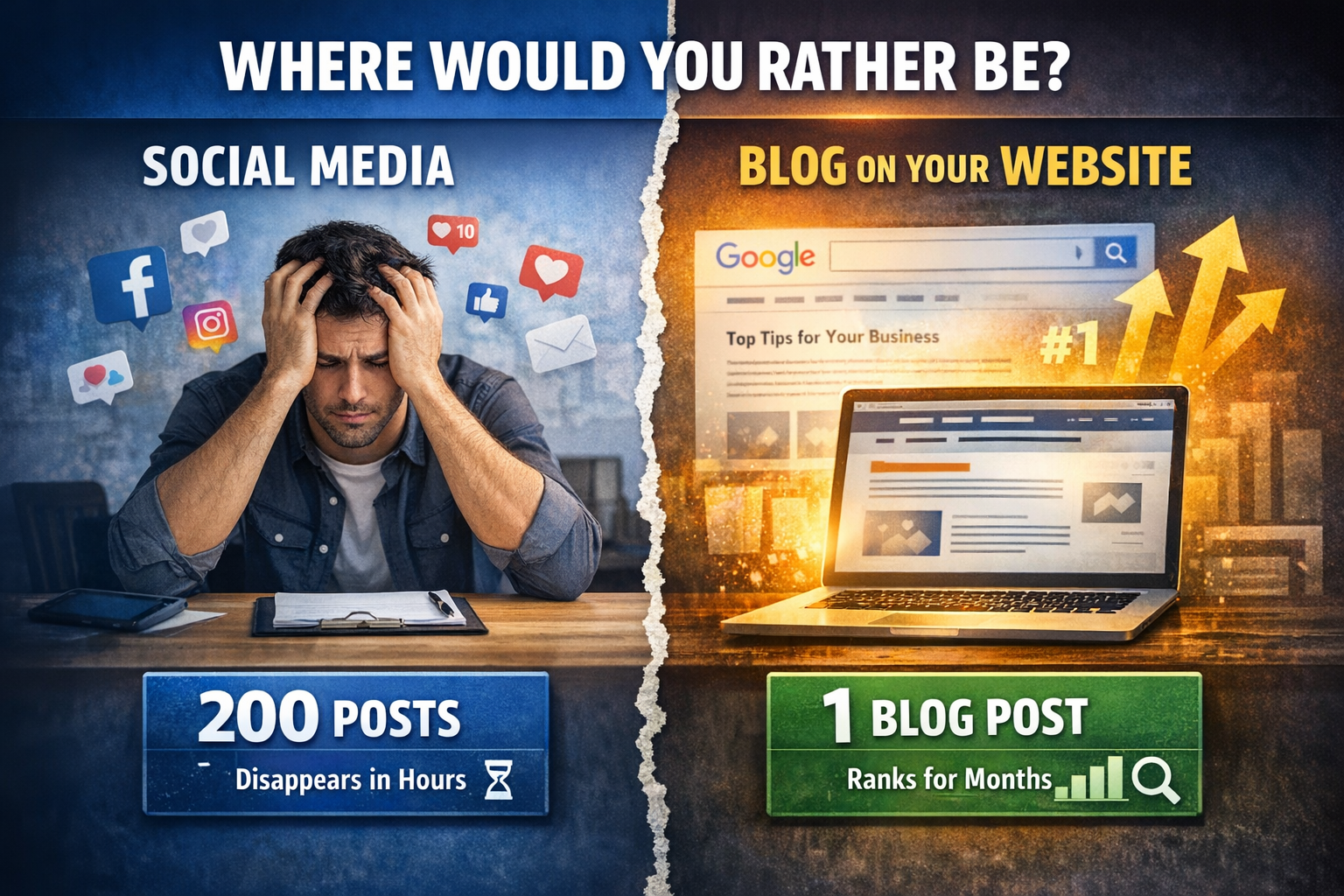
Where Social Posts Go to Die
Here's something most business owners feel but rarely put into words: posting on social media feels productive, but the results vanish almost immediately.
When you publish a Facebook post from your business page, the platform shows it to a small fraction of your followers. Not all of them, a fraction. Then the algorithm moves on. Within 6 to 24 hours, that post is functionally dead. It still exists on your page if someone scrolls far enough, but nobody is scrolling that far, and the algorithm certainly isn't resurfacing it.
Instagram works the same way, arguably worse for business accounts. The platform prioritises Reels, paid content, and accounts with high engagement rates. Your carefully written caption about your services has a window of a few hours before it's buried under the next wave of content.
This isn't a failure on your part. It's how these platforms are designed. Social media companies make money by keeping users on the platform, not by sending traffic to your website. Your content is fuel for their engine, not yours. You're building on rented land, and the landlord changes the rules whenever they like.
What we consistently see in the analytics of businesses we work with is that social media drives familiarity among people who already follow you, but it does very little to reach new customers who have never heard of you. That's a critical distinction.
What a Blog Post Actually Does for Your Website
A blog post on your own website works in a completely different way, and it starts with understanding what Google actually does.
Google sends automated crawlers across the web, reading and indexing pages. Every page on your website is a potential entry in Google's index, a potential answer to someone's search query. When you publish a blog post on your website, Google crawls it, reads the content, evaluates how relevant it is to specific search terms, and files it away. If the content is useful and well-structured, it can appear in search results for months or even years.
Here's the practical version of that. Imagine you run a construction business in Bedfordshire. If you write a blog post titled "How Much Does Drylining Cost in Bedfordshire?" and that post is genuinely useful, with real information about pricing factors, common project types, and what affects the final quote, Google can rank that page for anyone searching that exact question or something close to it.
That post doesn't expire after 24 hours. It doesn't get buried by an algorithm. It sits there, indexed, working for your business every time someone types that query into Google.
When we built the website for ZF Drylining, the entire site was structured with this in mind. Clear service pages, SEO-optimised URLs, proper meta tags, and lead generation forms on every key page. That structure means when blog content is added, it doesn't float in a vacuum. It connects to service pages through internal links, builds topical authority in Google's eyes, and funnels readers toward an enquiry. The technical foundation exists to make content actually count.
They Do Different Jobs
This isn't a case of blog posts being better than social media. They do fundamentally different things, and the problem is that most businesses are only doing one half.
Social media nurtures people who already know you exist. It keeps you visible in their feed, reminds them you're there, builds a bit of trust through familiarity. That has value, genuinely.
But blog posts capture people who don't know you exist yet. These are strangers who are actively searching Google for the service you provide or the question you can answer. They've never heard of your business. They've never seen your Instagram. They're typing a query into Google and looking for the best answer.
The customer journey looks like this: a stranger searches Google, finds your blog post, reads it, sees you clearly know what you're talking about, clicks through to your services page, and sends an enquiry. That entire journey, from stranger to potential customer, cannot happen from an Instagram caption. Google does not index your Facebook posts. Google does not crawl your Instagram captions. If all your expertise and useful content lives exclusively on social media, it is completely invisible to every person who searches Google for what you do.
Think about that for a moment. Every bit of knowledge, every tip, every answer you've shared in social media posts over the past year is invisible to search engines. It only ever reached the small percentage of your followers who happened to be online at the right time.
The Compounding Effect
This is where the real difference becomes impossible to ignore.
Social media is a treadmill. You have to keep posting to stay visible. The moment you stop, your visibility drops to zero. Last week's posts are already forgotten. You're starting from scratch every single day.
Blog content compounds. Your second blog post doesn't replace your first. It adds to it. Your fifth post doesn't make the first four irrelevant. All five are indexed, all five are working simultaneously, and each one reinforces the others in Google's assessment of your site's authority on a given topic.
After 12 months of publishing one blog post per month, you have 12 indexed pages on your website, each one a potential entry point for a customer searching Google. After two years, you have 24. Each post continues working long after you've moved on to writing the next one.
This is exactly the principle behind how we structured the Ezotrade website. Every product page and content section is built with SEO-optimised URLs and structured data, so each page serves as a persistent entry point from search. Not a one-time social media impression that evaporates, but a permanent, findable presence on the web. The same principle applies to any business that publishes useful content on a properly built website.
Social posts are conversations in a crowded pub that nobody remembers by morning. Blog posts are signposts on a road that customers drive down for years.
What Makes a Blog Post Actually Rank
You don't need to become a writer. You don't need to study SEO for six months. You need to follow a handful of practical steps.
Answer a specific question your customers actually search for. Not what you think sounds impressive, what real people actually type into Google. "How long does it take to plaster a room?" is better than "Our Commitment to Plastering Excellence."
Use that question, or something very close, in your page title and main heading. This is how Google understands what the page is about.
Write at least 600 words of genuinely useful content. Not filler, not fluff, actual information that answers the question properly. If someone reads your post and still needs to search Google again for the same answer, the post hasn't done its job.
Include internal links to your relevant service pages. If you mention a service in the blog post, link to the page on your site where someone can learn more or enquire. This helps readers and helps Google understand your site structure.
Make sure your site has the technical foundations in place. Proper meta tags, a sitemap submitted to Google, and Google Search Console connected so you can see what's actually happening. Without these, you're publishing into a void.
Every website we build from the Standard package upwards at MK TechLAB includes Google Analytics and Search Console setup as part of the build. Not as an optional extra, not as a follow-up task that gets forgotten, built in from day one. That means from the moment your first blog post goes live, you can see exactly which search queries are bringing people to your site, which posts are getting impressions, and which ones are converting into clicks. Content stops being a guessing game and becomes a measurable channel.
The Realistic Plan
The objection I hear most often is: "I don't have time to blog."
Fair enough. You're running a business. But here's the realistic version of what "blogging" actually looks like when it's done practically.
One post per month. That's it. Not one per week, not one per day. One per month.
Base it on a question a customer asked you that week. Every business owner gets asked the same handful of questions repeatedly. "How much does this cost?" "How long does it take?" "What's the difference between X and Y?" "Do I need planning permission for this?" Each one of those questions is a blog post.
The simplest method: open the voice recorder on your phone, talk through your answer for five minutes as if the customer were standing in front of you, and then turn that recording into a structured 600 to 800 word post. That's 20 minutes of real effort, once a month.
The return on that single monthly post, in long-term search visibility, far exceeds the return on posting to social media every day. Not because social media is worthless, but because social posts serve a different purpose and operate on a completely different timescale.
Keep posting on social media if it's working for your audience. But if you're only doing social and your website has no blog, you're running on a treadmill with no finish line. Every post you publish disappears within a day, and you start again tomorrow with nothing to show for yesterday's effort.
One blog post per month, on a website built to be found by Google, changes that equation entirely. You start building something that accumulates. Twelve months from now, you'll have twelve pages working for you around the clock, reaching people you've never met, answering questions you answered once and never had to answer again.
Social media and blog content are not interchangeable, and treating them as the same thing is costing you visibility where it matters most. Your Facebook and Instagram posts keep you in front of people who already follow you, and that matters. But they do nothing to help the stranger who just typed your exact service into Google and found your competitor instead. Every month without a blog post on your website is another month where Google has nothing new to index, nothing new to rank, and no reason to show your business to the people actively searching for what you offer. The businesses that show up on page one aren't always the ones posting the most on social media. They're the ones who put useful content on a properly built website and let search engines do the rest.